
Written by: Barloe Kanz, BS

Optimizing silage starts with mastering the fundamentals. This article outlines five science-backed strategies to preserve feed quality, improve digestibility, and reduce spoilage. Apply these principles to elevate your harvest and protect your bottom line.
KEY TAKEAWAYS
- Feed additives can increase your feed cost/cow/day significantly. Therefore, it is necessary for the producer and nutritionist to conduct a periodic review of feed additives in the diet to help control feed costs.
- Feed additives are included in the diet for specific reasons. It is up to the producer and the nutritionist to determine if those reasons are still valid today.
- Not all additives are created equal. Assess the research, experience on farms like yours, and proven returns on each unique product.
- Milk price should not be the sole determinant for using a feed additive. Either it’s helpful, or it’s not. Milk price will affect the ROI, but not the need.
- Use all your resources to get complete information and make an informed decision.
While the dairy industry has faced an economic downturn to begin 2026, a fact brought into clearer focus is that feed costs are the single highest input expense for dairy farmers; feed costs are estimated to range from 40 to 60% of total costs on most dairies. Forage and commodity costs will vary year-to-year based on weather, exports, and demand for different crop uses (human vs. livestock vs. biofuel production). On the flip side, the nutrients necessary to feed a high producing dairy cow do not change; A primary role of the nutritionist is to find the ideal combination of ingredients (at best cost) to supply these nutrients, which will fluctuate with ingredient markets. A secondary factor that can significantly affect overall feed costs is what we refer to as “feed additives”. Feed additives are any ingredient added to the diet beyond the cow’s basic carbohydrate, protein, fat, vitamin and mineral needs. It seems there is no end to this list with products that offer to optimize rumen function, reduce digestive upsets, improve feed efficiency, enhance components, support hoof health, improve transition cow health or reproduction, among other things. Therefore, it is up to the nutritionist to assist producers with navigating which additives may be appropriate to meet their unique needs.
Additives are sometimes used to address a short-term situation, for example, higher toxin levels in a forage or recovery from a heat stress period. It is easy to see that feed additives are typically added to the diet for good reasons, however, a periodic review of additives in the diet is necessary to assure the nutrition program stays on track, and that we prevent “additive creep”. It is possible to see additive costs in a diet add up to $0.50 to $1.00/cow/day, or even more.
Here is a specific example, with rough associated costs, to see how this can happen. It demonstrates how quickly the cents add up:
The nutritionist believes every diet should include monensin ($0.05) for feed efficiency and a yeast product ($0.05) to help stabilize rumen function. Next, a binder ($0.15) was added to deal with higher than desired toxin levels. They wanted to be proactive with increasing day length and warmer temperatures coming and added a supplemental potassium cation source ($0.20), and by fall, the dairy experience more hoof lesions than typical, so biotin was added and organic trace minerals were increased ($0.08). By winter, we have $0.50/cow/day in additives in the diet. This then raises the question: Are all of these still necessary? Of course, the answer is “it depends” on your unique situation, which will vary from year to year, which is why a periodic review of additives is a great idea and should be done quarterly or bi-annually, at a minimum. Auditing feed additives is not always centered around lowering feed cost. Feed additives can serve to strategically support profitability. If an additive provides a positive ROI, it is advised to continue its use. Auditing a ration is more about ensuring a balance between cost and performance.
A 5-Step Audit That Takes the Guesswork Out
- Identify why the additive was originally added to the diet. Does that need still exist? Has the underlying problem been removed? This question is best answered via good records around the nutrition program. Why and when did we add this additive? If it appears the feed additive is no longer necessary, then the additive could likely be removed without any negative consequences.
- Measure if the additive has performed as intended. Was the desired result achieved? If the underlying problem was not resolved and still exists, did the additive help improve the situation? If no, then we should remove the additive and/or look at alternative solutions. If yes, it should be continued.
- If still needed, evaluate if the additive provides the most cost-effective solution. Are there new or different options that need to be considered? New products are constantly being researched and brought forward to the market. Therefore, it is necessary to consider whether the additive that is used is still the best and most cost-effective option in the market. An example here might be replacing a product with a new product equivalent in performance but at a lower price point.
- Understand the strength of research and/or relevant farm-level results. Not all additives are created equal. Some have a known mechanism of action, large amounts of research, and a solid technical team to back it up. Some don’t. Are you working with a proven product with a highly repeatable outcome? Does the supplier offer on-farm support to validate performance?
- Calculate the affordability. Does it add a positive return OR mitigate a negative outcome? It is often said: “milk price is down, so pull these additives out of the diet.” If the product is working, it is either bringing a positive benefit (i.e. better components) OR minimizing a negative (i.e. fewer hoof problems). In either case, it is bringing value. In reality, milk price should NEVER be the sole criteria for whether or not to feed an additive, unless the ROI is severely diminished or disappears. If an additive is removed for cash flow reasons, it is likely that cash flow will get worse, not better.
When conducting an additive audit, you should consider all of your available resources for information. Include your nutritionist, veterinarian, and the product sales and technical support team. Challenge the product sales team with direct and simple questions about the additive’s abilities and what might be expected if included in your diet. From their experiences, in what situations has this additive worked best? Ultimately, the decision to use additives in the diet lies with the producer. A producer should surround themselves with advisors that do not have a personal financial gain in a decision to use an additive. Sales representatives from the company should be relied on to provide information to make a good decision, but they are not the ones making it. Surrounding yourself with unbiased advisors will allow you (the producer) to make the most informed decisions regarding health, production and economic impact on your operation.
Did Removing That Additive Actually Save Money?
ROI, or return on investment, is critical when evaluating the economic impact of a nutritional decision. Below is an example of a practical process for evaluating and calculating an ROI.
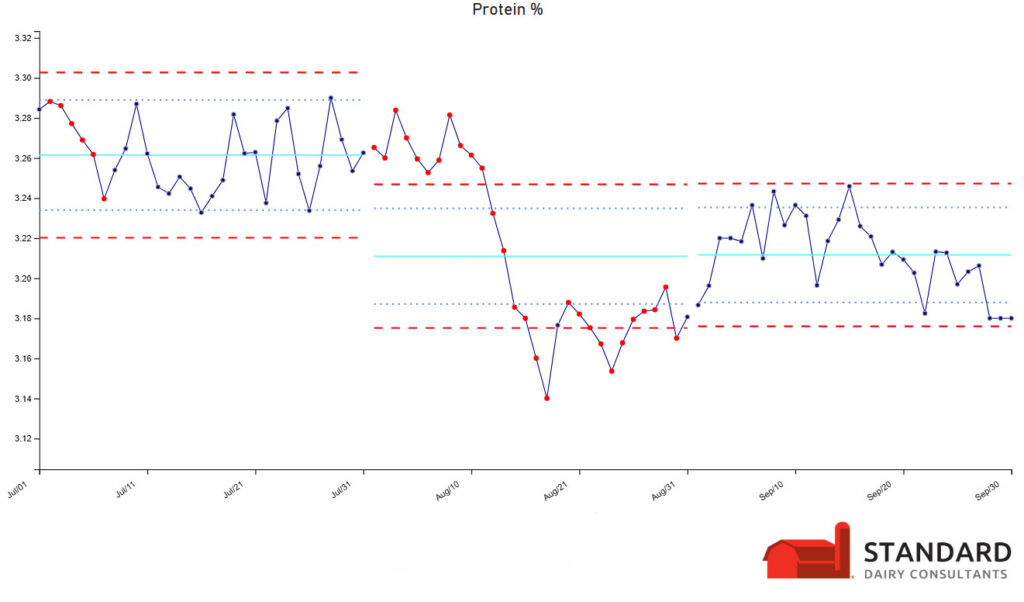
Statistical process control (SPC) charts can help to evaluate statistical changes, such as butterfat % over time. Blue points indicate normal variation around the mean, while red points indicate trends or “real” changes when values deviate significantly from the mean over a given time frame.
Scenario:
A dairy farm, looking to cut costs, has made the decision to remove 10 g of a rumen protected methionine product from the diet. Using a statistical process control chart (image above), they noted a statistically significant decline in milk protein % after the product was removed; they went from 3.26% to 3.21%, on average. Milk yield also decreased from approximately 90 to 89 lbs. Based on the production decline and current market conditions, what was the original ROI, and did they save money by removing?
Step 1: Calculate the product cost in the diet
Rumen protected methionine: $12,500/Ton
$12,500 / 2000 lb = $6.25/lb
10 g = 0.022 lbs x $6.25/ lb = $0.138 per head per day cost of product
Step 2: Calculate the value of the milk protein.
Milk protein value: $2.18/lb
With product:
90 lbs milk x 3.26% = 2.93 lbs of proteinWithout product:
89 lbs milk x 3.21% = 2.86 lbs of protein2.93 – 2.86 = 0.07 lbs of protein x $2.18 = $0.153 per head per day value of milk protein
Step 3: Calculate the ROI
ROI = (Net Profit/Cost of Investment) x 100
(($0.153–$0.138) / $0.138) x 100 = 10.9% ROI
In this case, the dairy had been experiencing a small ROI prior to removing the product from the diet. Removing the methionine product would reduce ration cost by about $0.14 per head, however, they also would lose the $0.15 of milk revenue attributed to the product.
Calculating the ROI of nutrition decisions is a simple yet powerful exercise for quantifying their impact. It often helps put the exchange of dollars into perspective and gauge the magnitude of profitability.
What to run these numbers for your own herd?
Our experienced team knows how to apply their knowledge to your specific operation in ways that directly impact your efficiency and performance and, ultimately, your profitability.
